


Connect and power IP cameras, wireless access points and industrial field devices with EtherWAN PoE switches and PoE media converters. Choose managed networking, plug-and-play connectivity or a fiber-to-PoE connection.
Start with the device: match its PoE standard, the number of powered connections and your uplink. Then check the total PoE budget for the selected ordering model.
Explore our PoE portfolio

EX75900 Series
Rackmount managed PoE switch with IEC 62443-4-2 certified cybersecurity, routing and redundant power inputs.

EX78900G Series
Compact managed PoE switch with ERPS ring redundancy, Layer 3 routing and RESTful API integration.
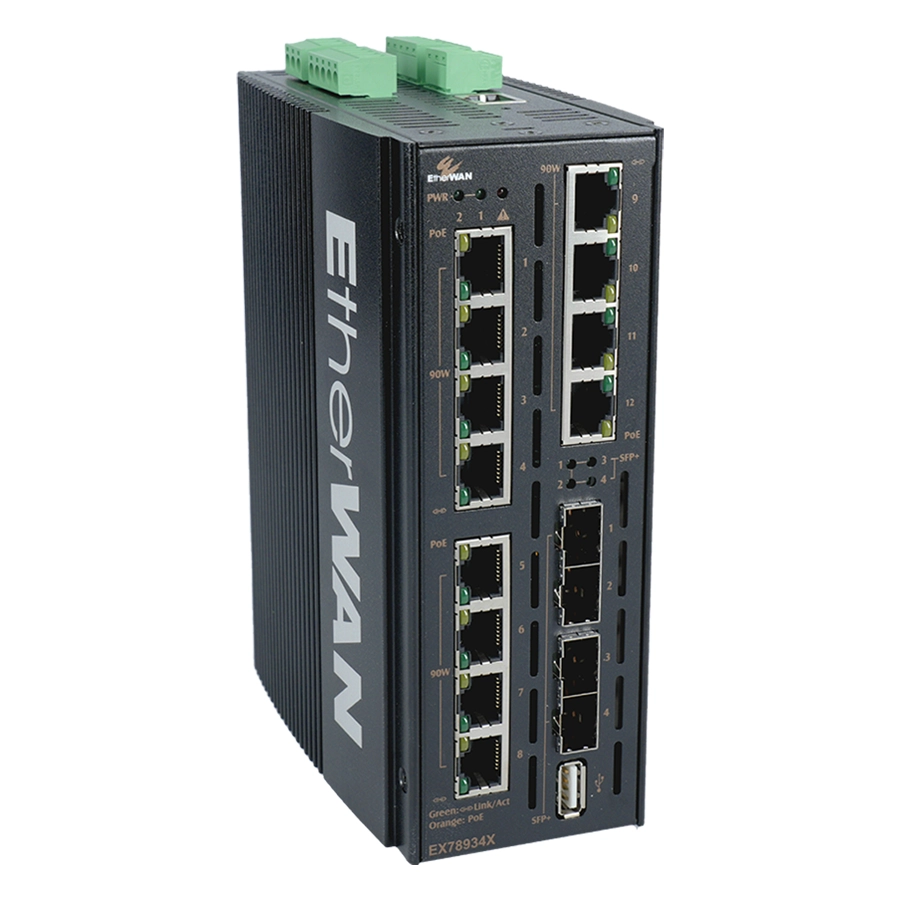
EX78900X Series
Managed PoE switch with certified cybersecurity, Layer 3 routing and centralized network management.
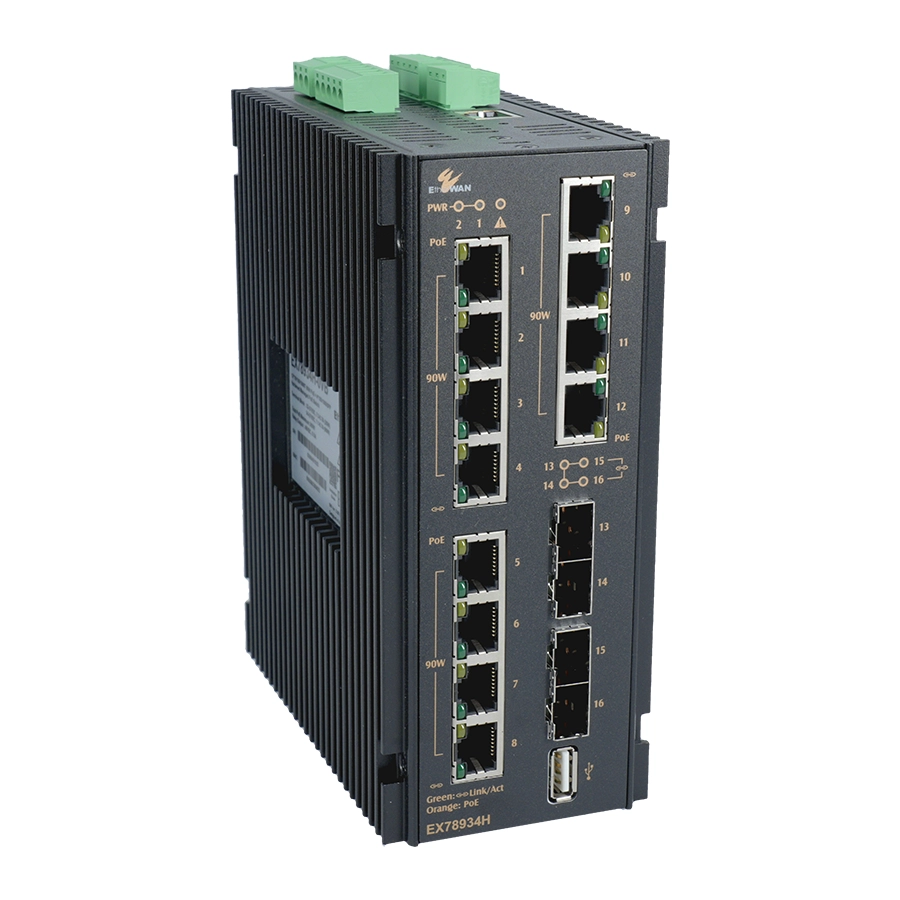
EX78900H Series
Managed PoE switch with time synchronization and redundant power inputs.

EX78900E Series
Managed PoE switch with certified cybersecurity and integrated alarm interfaces.

IG5 SV Series
Managed PoE switch with GOOSE support and precise time synchronization.

OttoE PoE 10H GE
Unmanaged PoE switch with surge protection, prioritized traffic and push-in terminals for easier wiring.

OttoE PoE 08H GE
Unmanaged PoE switch with surge protection, prioritized traffic and per-port device recovery.

OttoE PoE 10 GE
Unmanaged PoE switch with prioritized EtherNet/IP and PROFINET traffic, plus push-in terminals.

OttoE PoE 08 GE
Unmanaged PoE switch with surge protection, prioritized traffic and per-port device recovery.


No matching products
Remove a filter or reset your selections.
Results show series with a model offering at least the required PoE port count. The power filter uses the series’ maximum single-port output; not every port necessarily supports that rating. Confirm the exact model, high-power port count, total PoE budget and supply requirements before ordering.
High-power devices. A stronger uplink.
For power-intensive edge devices, compare 90 W PoE capability with the total power budget. For aggregated traffic, choose the uplink bandwidth independently of the PoE port speed.
Find the right fit for your network
Manage the network →
Choose managed PoE switches for network configuration, monitoring and traffic control.
Deploy with less setup →
Choose unmanaged PoE switches for plug-and-play device connectivity and power.
Connect over fiber→
Use a PoE media converter to connect a fiber link to a copper PoE device.
Industrial PoE FAQs
Should I choose a managed or unmanaged PoE switch?
Choose a managed PoE switch when you need network configuration, monitoring or traffic control, such as VLANs and supported redundancy protocols. Choose an unmanaged PoE switch for plug-and-play connectivity without network configuration. Both types supply power to compatible devices; management features and PoE capacity are separate specifications.
What is the difference between PoE, PoE+ and PoE++?
PoE, PoE+ and PoE++ refer to different IEEE power standards. PoE++ includes two types with different maximum power outputs.
| Name | IEEE standard | Type | Max. output per port |
|---|---|---|---|
| PoE | 802.3af | Type 1 | 15.4 W |
| PoE+ | 802.3at | Type 2 | 30 W |
| PoE++ | 802.3bt | Type 3 | 60 W |
| PoE++ | 802.3bt | Type 4 | 90 W |
Power available at the device is lower because of cable losses. Match the device’s required IEEE PoE standard and power class; PoE++ does not always mean 90 W.
How much total PoE budget do I need?
The total PoE budget is the power available across all PoE ports combined. Supplying 30 W on each of eight ports requires a 240 W budget. An eight-port switch with a 120 W budget cannot deliver 30 W on all eight ports simultaneously, even if each port supports 30 W. Available power may vary with the power supply and operating temperature.
| Power per port | Ports powered simultaneously | Required total PoE budget |
|---|---|---|
| 30 W | 4 | 120 W |
| 30 W | 8 | 240 W |
Can a 90 W PoE port power a lower-power device?
Yes, when the port supports the device’s IEEE PoE standard and power class. A standards-compliant PoE port detects and classifies the powered device before supplying operating power; a 90 W rating is its capacity, not power forced into the device. Check backward compatibility and the total PoE budget. Passive PoE does not use the same detection and classification process.
Does a 10G uplink make every PoE port 10G?
No. A 10G uplink carries aggregated network traffic, while each PoE device port operates at its own specified speed. A switch can have 1 Gbps PoE ports and 10G SFP+ uplinks. Select device-port speed for each connected device and uplink capacity for their combined traffic; PoE wattage does not determine data speed.
Can a PoE media converter deliver power over fiber?
No. A standard fiber link carries data, not electrical power. A PoE media converter receives data over fiber and uses a local power supply to deliver data and PoE through its copper Ethernet port. Use it to connect a remote PoE device over fiber when suitable power is available at the converter location.


